
· by Michael Blair, Nashville's Drywall Repair
People ask for a smooth ceiling because they are tired of looking at the old one: a texture they never liked, a brown ring from a leak upstairs, a seam that shows every evening when the lamps come on. A ceiling is less forgiving than any wall in the house, and a refinish that looks fine at noon can show every trowel mark at five o’clock. Getting it right is mostly about the order of the work: fix what is wrong with the board, build a flat surface over it, and paint it with something that does not throw light back. This is how our ceiling repair crews approach it.
Why a ceiling shows what a wall hides
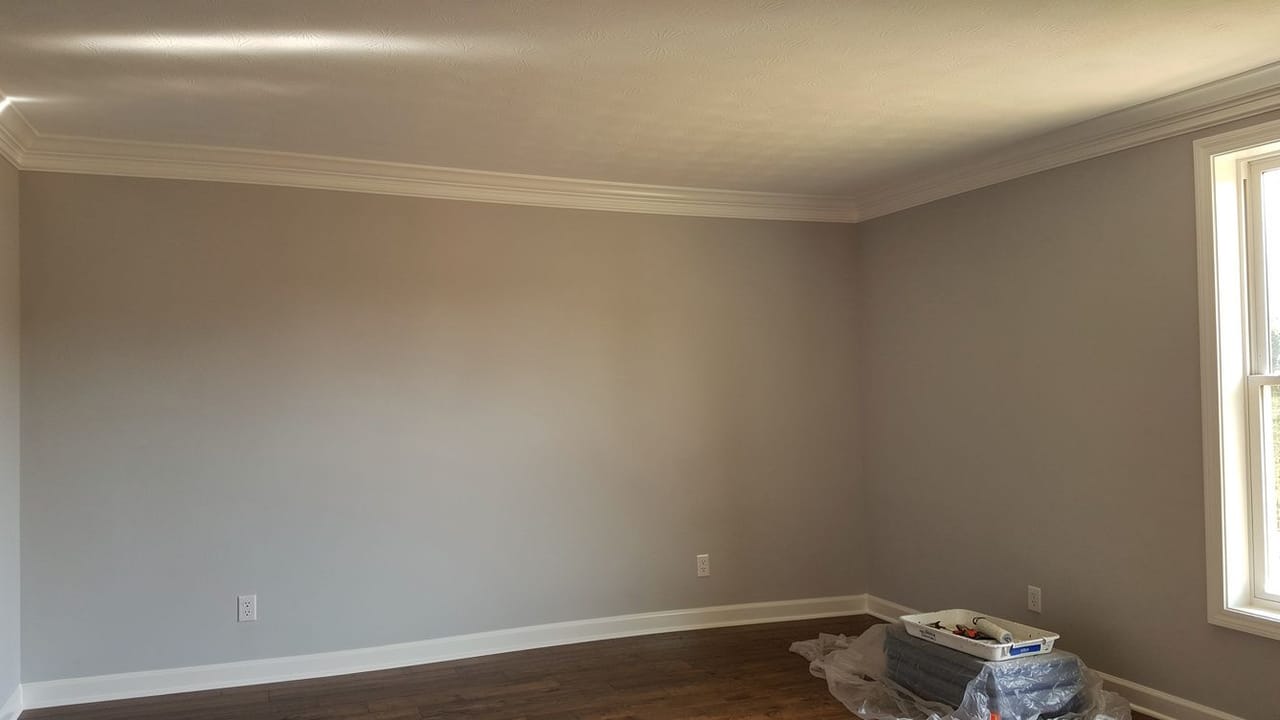
Light almost never hits a ceiling straight on. It comes in from windows near the top of the wall, from a fixture mounted flush to the ceiling, from a lamp on a side table, and it slides across the surface at a shallow angle. That angle turns a ridge the thickness of a credit card into a shadow a foot long. The Drywall Finishing Council’s guidance on levels of finish calls this critical lighting and describes surfaces flooded with light at an oblique angle from large windows, skylights or surface-mounted fixtures.
Plenty of Middle Tennessee houses have exactly that: open great rooms with a wall of windows facing west, vaulted ceilings in the newer subdivisions around Spring Hill and Murfreesboro, and a row of recessed cans washing across the flat. A ceiling in one of those rooms has to be built for the worst light it will see, not the light in the room when the estimate is written. We look at it with a work light held flat against the surface, because that shows what the afternoon sun will.
Repairs come before the smooth coat
A skim coat makes a ceiling flat. It does not fix anything underneath it. A water stain will bleed through new compound and new paint unless it is sealed first, and the leak behind it has to be stopped before anything else; Zinsser’s Bulls-Eye 1-2-3 Plus data sheet says to make sure all water leaks are repaired before priming a water stain, says the primer blocks stains from water, and notes that some applications need a second coat. Board that got soaked and softened is cut out and replaced, which is its own job; our water-damaged drywall page covers that part.
Cracks get the same treatment. A seam that has opened is cut back to sound tape, re-taped and coated, because compound smeared over a moving crack just cracks again in the same line. A sag, where the board has pulled away from the joists between fasteners, gets pulled back up and re-fastened, or replaced if the gypsum has broken. Skim compound will not hold up a sagging panel, and a smooth coat over a dip makes the dip easier to see.
- Leak stopped, then the stain sealed with a stain-blocking primer
- Soft or crumbling board cut out and replaced
- Open seams cut back and re-taped
- Sagging panels pulled tight to the framing or replaced
Skim-coating over old texture or damage
Once the board is sound, the whole ceiling is coated, not just the repairs. A light texture such as orange peel or a flattened knockdown can usually be skimmed over after the high points are knocked down and the surface is primed. A heavy popcorn texture comes off first; scraping it is a different job with its own preparation, and our post on removing a popcorn ceiling walks through it. Whatever is up there, the U.S. EPA notes that textured paint and patching compounds on ceilings are among the places asbestos may be found, and that lab testing of a sample taken by an accredited inspector is the only way to be sure, so an old texture we have not had tested does not get sanded.
The compound matters. USG’s Sheetrock setting-type compound submittal says not to use setting-type compounds for thin skim coats and points to ready-mixed compound instead, and USG describes its All Purpose ready-mix as excellent for skim coating. We use setting compound to fill deep repairs where it belongs and ready-mix for the broad coats over the whole ceiling.
Drying sets the pace. USG puts ready-mix at about 24 hours to dry at 70 degrees and 70 percent humidity and says higher humidity or lower temperatures slow it down. A Nashville July with the windows open is well past 70 percent, so we run the air conditioning and keep the house closed while the coats cure. Each coat is applied thin, sanded lightly, and checked with the work light before the next goes on.
Level 5, flat paint and a clean house
The industry describes how finished drywall is in levels. In the Gypsum Association’s repair and painting article, Level 4 means taped joints with two more coats of compound and three coats on fasteners and accessories, and Level 5 adds a skim coat over the entire surface once Level 4 is reached. The same article says Level 5 belongs where severe lighting is likely to highlight surface irregularity, whatever paint is used, and the Drywall Finishing Council recommends Level 5 under critical lighting. A smooth ceiling refinish is a Level 5 job by definition. Our post on drywall finish levels explains the lower levels and where each one fits.
The paint finishes the work. We put flat ceiling paint on every ceiling we refinish. Sherwin-Williams sells its ProMar interior ceiling paint only in flat and describes it as a non-reflective appearance that helps hide surface imperfections. Any sheen on a ceiling turns raking light into a mirror for whatever is left in the surface.
Then there is the dust. Sanding a whole ceiling makes a lot of it, and USG’s submittal for its setting powder carries a respirable crystalline silica warning and recommends a sander with a vacuum attachment or wet sanding to keep the dust down. We sand with vacuum-attached sanders, hang plastic at the doorways, cover the return air grilles so the HVAC system does not spread it through the house, and clean up at the end of each day. If your ceiling is ready for this, ask us for a free estimate.
Sources
- Drywall Finishing Council, Recommended Levels of Paint Finish Over Gypsum Board (rev. 2017) — Definition of critical lighting; Level 5 recommended under critical lighting.
- Gypsum Association, Repair and Painting (Walls & Ceilings, 2004) — What Level 4 and Level 5 require; Level 5 where severe lighting highlights irregularities.
- Zinsser Bulls-Eye 1-2-3 Plus technical data sheet — Blocks stains from water; repair leaks first; some applications need a second coat.
- USG Sheetrock Durabond setting-type joint compound submittal J17A — Setting compounds not for thin skim coats; silica warning and dust-control advice.
- USG Sheetrock All Purpose Joint Compound — Suited to skim coating; about 24 hours to dry at 70 degrees and 70 percent humidity.
- Sherwin-Williams ProMar Interior Latex Ceiling Paint — Flat-only ceiling paint, non-reflective to help hide surface imperfections.
- U.S. EPA, Learn About Asbestos — Textured paint and patching compounds on ceilings listed among places asbestos may be found.
- U.S. EPA, How Do I Know If I Have Asbestos in My Home — Lab testing of a sample taken by an accredited inspector is the only way to be sure.