
· by Michael Blair, Nashville's Drywall Repair
Of all the cracks we are asked to fix, the one that runs up from the corner of a door or window is the one most often patched before we arrive. It gets filled, painted, and a season or two later the same line is back. The reason is usually in how the board was hung around the opening, not in the patch. Here is what the gypsum industry’s own standards say about seams at openings, why filling the line rarely holds, and how we approach drywall repair when the crack is a repeat.
Why does drywall crack at the corners of door and window openings?
Drywall cracks at the corners of door and window openings mostly because a board seam lands at or near the corner, and that seam becomes the line the wall breaks along. National Gypsum’s guide to control joints quotes the Gypsum Association’s GA-216 standard calling cracks at the corners of openings a common problem. To prevent them, GA-216 does not allow gypsum board joints within 12 inches of those corners unless a control joint is installed there.
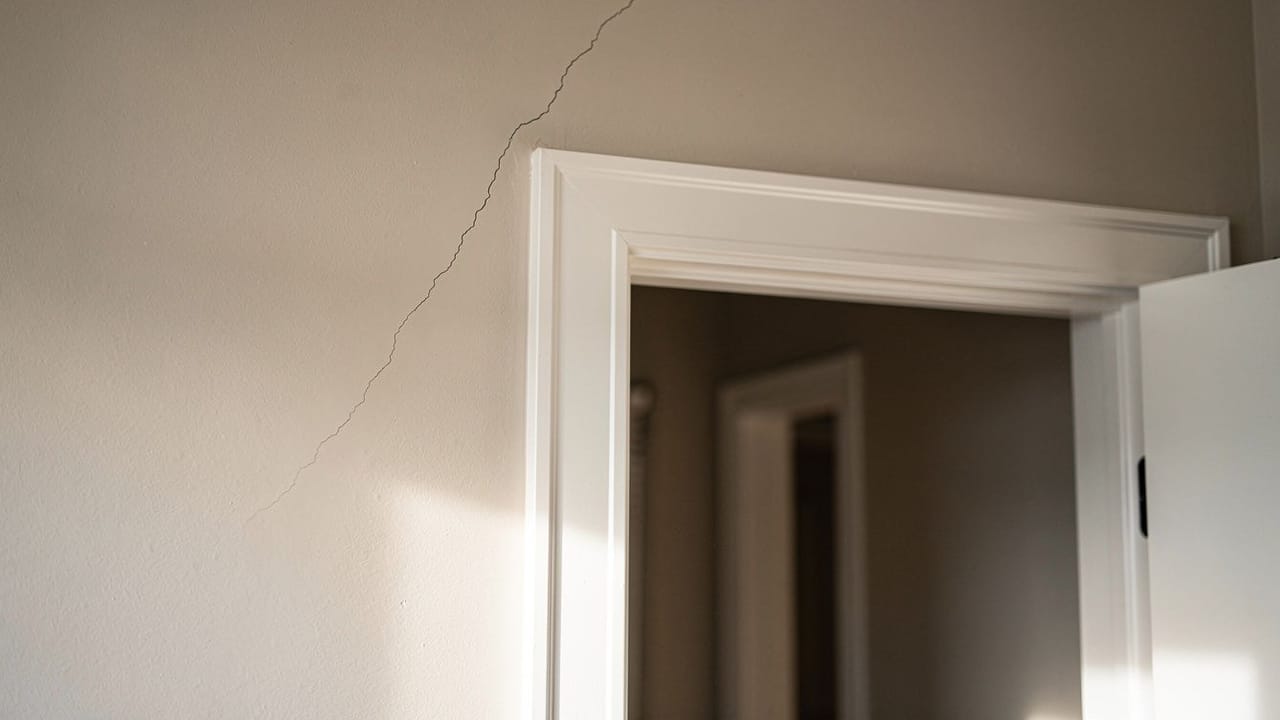
That rule is written for people hanging new board, but it tells anyone repairing an old wall where to look. When we see a line climbing diagonally from the head of a door frame or the top corner of a window, the first thing we check under the paint is whether a seam starts there, and how close to the corner it sits. Cracks that begin in the middle of a sheet, away from any seam or opening, are a different conversation.
How is drywall supposed to be hung around a door?
Around a door, the drywall standards expect one of two things: board cut to wrap the corner, or a control joint at the jamb. The Department of Veterans Affairs’ gypsum board specification, published through the Whole Building Design Guide, calls the first one yoked board, meaning the board is cut out around the opening so there is no joint along the jamb or above the door.
Where the board is not yoked, the same specification, following ASTM C840, puts control joints at both side jambs, running the full height of the wall. National Gypsum’s newsletter on specifying control joints quotes the Gypsum Association’s guidance the same way: control joints at the corners of window and door openings, with the joint’s cavity left unfilled. Separately, its control joint FAQ calls for them on any wall running in one uninterrupted plane for more than 30 feet.
All of that is guidance for hanging new board. It explains why a crack is there; none of it is a recipe for repairing one after the fact.
Why does a patched crack above a door keep coming back?
A patched crack above a door keeps coming back because the patch covers the line without changing what caused it. If the crack follows a seam at the corner, fresh compound and paint put back the same weak point that broke the first time, and the wall goes on doing what it did before.
The gypsum industry is direct about trying to get by without the joints. Asked in National Gypsum’s guide whether control joints can be cut back or left out where looks matter most, the answer is no, not without risking cracks, and the joint design is the same for half-inch or five-eighths board. The instruction to leave a control joint’s cavity unfilled points the same way: a place built to move does not hold rigid compound.
So the honest answer to a repeat crack is that another skim coat buys time. If the line has opened once after a careful repair, it is telling you the corner itself needs to change.
When is a door-corner crack more than a drywall problem?
A door-corner crack is more than a drywall problem when it keeps widening, runs well beyond the corner, or arrives with a door that starts to bind or a gap that opens over the frame. Those point at the framing or the foundation, and we would rather have the structure looked at before we tape anything.
For an ordinary seam crack, our approach is simple to describe. A first-time crack gets opened up, re-taped and finished, with the texture matched so the repair does not show. A crack that has come back after a proper repair gets the corner changed instead, either by giving the wall somewhere to move at that point or by replacing the piece over the opening with board cut to wrap the corner. Seam and nail-pop cracks elsewhere in the room are covered in our post on nail pops and cracked seams.
If you are in Hendersonville or anywhere nearby with a crack that keeps reopening at a door or window, send us a photo of it along with how long it took to come back.
Sources
- National Gypsum Company, Control Joints: What You Need to Know (2023) — Quotes GA-216: cracking at the corners of door and window openings is a common problem; no board joints within 12 inches of those corners unless control joints are installed; control joints cannot be reduced for looks without risking cracks; same design for 1/2 and 5/8 inch board
- National Gypsum Company, Design Resource Center FAQ: Control Joints — Control joints where a wall runs in one uninterrupted plane over 30 linear feet; cites GA-216 and ASTM C840
- National Gypsum Company, Why Specify Control Joints — Quotes the Gypsum Association: control joints at the corners of window and door openings; control joint cavity not filled
- U.S. Department of Veterans Affairs, Section 09 29 00 Gypsum Board (2020), via the Whole Building Design Guide — Defines yoked board; per ASTM C840, control joints at both side jambs where board is not yoked, full wall height
FAQ
Drywall Cracks at Door and Window Corners — questions
What causes cracks above a door frame in drywall?
Most often a board seam that lands at or near the top corner of the opening. National Gypsum, quoting the Gypsum Association’s GA-216, calls cracking at the corners of door and window openings a common problem and says board joints should stay at least 12 inches from those corners unless a control joint is installed.
What is a control joint in drywall?
A control joint is a deliberate break in the board where the wall is allowed to move, so the movement does not crack the surface somewhere else. The gypsum standards place them at the corners of door and window openings where board is not cut to wrap the corner, and on long uninterrupted walls, with the joint’s cavity left unfilled.
How far should a drywall seam be from a door corner?
At least 12 inches, according to the Gypsum Association’s GA-216 as National Gypsum quotes it, unless a control joint is installed at that corner. The Department of Veterans Affairs specification describes the alternative: board cut out around the opening, called yoked, so no joint runs along the jamb or above the door at all.
Are cracks in drywall normal?
A hairline crack at a door or window corner is common enough that the gypsum industry calls it a common problem, and it usually traces back to a seam placed near the corner. Common is not the same as nothing to watch, though: a crack that keeps widening or comes with a sticking door deserves a structural look.
When should I worry about cracks in drywall?
Worry when a crack keeps getting wider, runs a long way past the corner it started from, or shows up alongside a door that binds or a gap opening over its frame. Those signs point at framing or foundation movement rather than the board, and the structure should be checked before anyone patches the wall again.