
· by Michael Blair, Nashville's Drywall Repair
People call us for sheetrock repair and for drywall repair, and they mean the same wall. The two words are not quite the same thing, though, and the difference has a practical edge when a piece of board is cut out and replaced. Here is what Sheetrock is, what a patch has to match, and what the residential code Tennessee adopted says about the board behind it, as it applies to drywall repair in a Nashville house.
Is Sheetrock the same as drywall?
Sheetrock is a brand, and drywall is the product. USG sells its gypsum panels under the Sheetrock name, as on its product page for Sheetrock Brand UltraLight Panels, and other makers sell gypsum board under names of their own. Drywall, gypsum board and wallboard all describe the same kind of panel: a gypsum core with paper faces, the face paper folded around the long edges.
USG lists its half-inch UltraLight panel and its UltraLight Tough panel as complying with ASTM C1396, the standard specification for gypsum board. That shared standard is why the name printed on the back of a panel matters less to a patch than its thickness and its edge.
What does a drywall patch have to match?
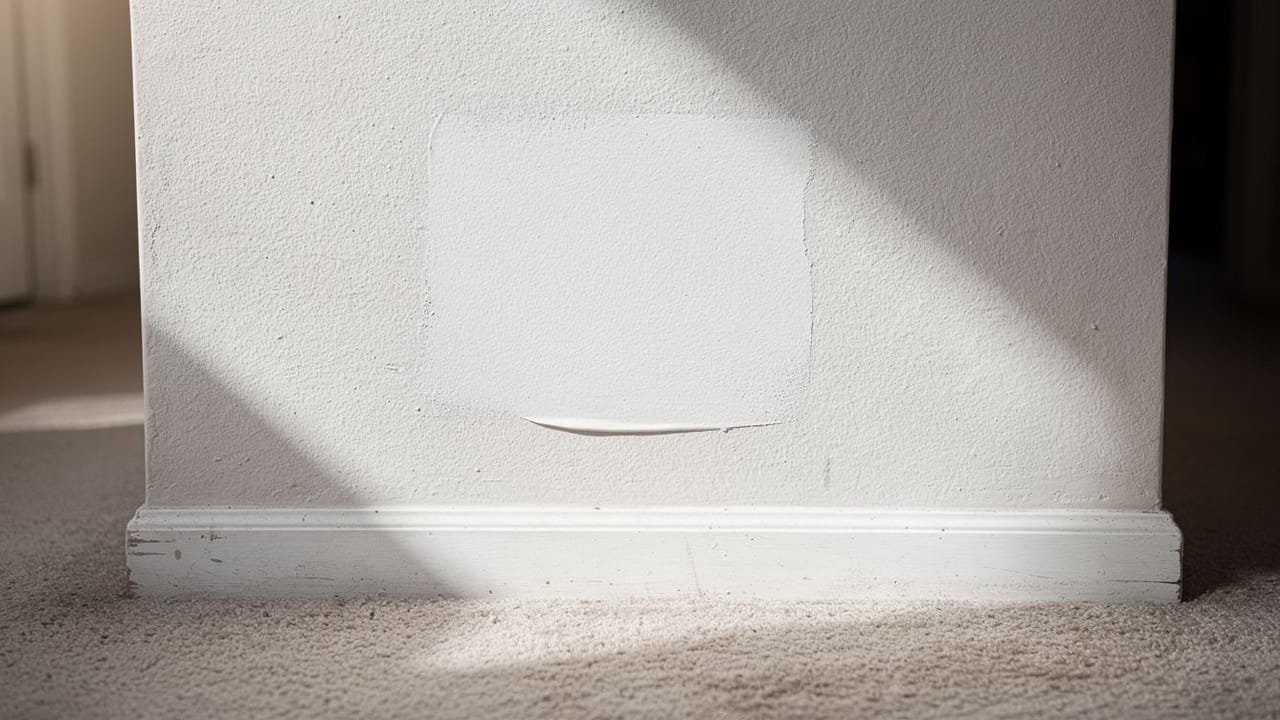
Thickness first, then the edge. A replacement piece has to sit flush with the board around it, so a half-inch wall gets half-inch board and a five-eighths ceiling gets five-eighths. We measure the cut edge of the old board before choosing the new piece, because a patch that sits proud or sunken shows through every coat of paint that follows.
The long edges of USG’s panels are tapered, which leaves a shallow recess where two sheets meet for the tape and compound. A patch that crosses one of those factory seams has to keep the recess, or the finished joint ends up as a raised band. How smooth the patch is finished afterward is a separate choice, set out in our post on drywall finish levels.
Can Sheetrock get wet?
Standard panels are not made for it. USG lists moisture resistance as No for both of its UltraLight half-inch panels, and the 2018 Tennessee Residential Code, Section R702.3.5, says interior gypsum board shall not be installed where it is directly exposed to weather or water.
So a lightweight half-inch panel is the right replacement for a hallway or bedroom wall and the wrong one for the wall behind a tub. Where water was the reason for the repair, the leak comes first, and our page on water-damaged drywall covers what has to come out. Our post on drywall for bathrooms and basements covers moisture-resistant board and shower backers.
Ceilings: thickness, spacing and texture
Table R702.3.5 in the same code sets the minimum board for a ceiling by the framing behind it. Half-inch board is allowed on ceiling framing 16 inches on center in either direction, and on 24-inch framing only when it runs perpendicular to the joists. Five-eighths board is allowed at 16 inches either way and at 24 inches perpendicular. A garage ceiling beneath living space takes five-eighths Type X, perpendicular, at 24 inches, which our post on Type X drywall explains.
A water-based texture raises the bar: the table’s note moves half-inch board up to five-eighths on 24-inch framing, unless half-inch sag-resistant ceiling board is used. USG says its UltraLight panel has enough sag resistance to stand in for a traditional half-inch sag-resistant ceiling panel. When we replace a section of ceiling, the new piece follows the same table as the original.
This is the 2018 edition of the International Residential Code as Tennessee adopted it. A city or county can adopt a newer edition, so the permit office for your address has the final word. For a patch in Nashville or anywhere nearby, send us a picture of the damage with a note on what caused it.
Sources
- UpCodes, 2018 Tennessee Residential Code, Chapter 7, Section R702.3.5 and Table R702.3.5 — Interior gypsum board not installed where directly exposed to weather or water; minimum ceiling board thickness by framing spacing and direction; Type X at garage ceilings beneath habitable rooms; water-based texture footnote.
- USG, Sheetrock Brand UltraLight Panels — Half-inch, tapered edge, face paper folded around the long edges; moisture resistance: No; complies with ASTM C1396; sag resistance claimed to replace half-inch sag-resistant ceiling panels.
- USG, Sheetrock Brand UltraLight Tough Panels — Half-inch, tapered edge; moisture resistance: No; ASTM C1396.
FAQ
Sheetrock or Drywall: What It Means for a Repair — questions
Is Sheetrock a brand name?
Yes. Sheetrock is the name USG sells its gypsum panels under, such as Sheetrock Brand UltraLight Panels. Drywall, gypsum board and wallboard are general names for the same kind of product, a gypsum core faced with paper, and other makers sell it under their own brand names.
Can you patch Sheetrock with another brand of drywall?
Yes, as long as the thickness and edge match. USG’s half-inch panels comply with ASTM C1396, the standard specification for gypsum board, which other makers’ board meets as well. A patch has to sit flush with the old board, and one crossing a factory seam has to keep the tapered recess.
Is lightweight drywall moisture resistant?
Not the standard panels. USG lists moisture resistance as No for its UltraLight and UltraLight Tough half-inch panels. The 2018 Tennessee Residential Code says interior gypsum board shall not go where it is directly exposed to weather or water, so wet areas need a board made for them.
What thickness of drywall goes on a ceiling?
It depends on the framing. Under the 2018 code Tennessee adopted, half-inch board works on joists 16 inches apart, or 24 inches apart if run perpendicular. Five-eighths is allowed at 16 inches either way and 24 perpendicular, and a water-based texture on 24-inch framing calls for five-eighths or half-inch sag-resistant board.