· by Michael Blair, Nashville's Drywall Repair
A hole in a wall built after 1978 is a drywall question. The same hole in an older East Nashville bungalow, a 1950s ranch in Inglewood or a 1960s split-level in Franklin is also a paint question, because the wall around it may carry layers of paint from before lead was taken off the shelf. Patching drywall means cutting, scraping and sanding the surface those layers sit on. Here is when the federal lead rule covers that work, how the size of a repair is measured, and what lead-safe patching involves, written for drywall repair in an older house.
Does the EPA lead rule apply to a drywall repair?
It does when someone is paid to do work that disturbs painted surfaces in a home built before 1978, unless the job is small enough to count as minor repair. The EPA’s Renovation, Repair and Painting Program page says the federal government banned lead-based paint for homes in 1978 and that roughly three-quarters of the homes built before then still contain some of it. The rule requires every firm paid for that kind of work, sole proprietors included, to be certified and to have its workers trained in lead-safe practices.
For a drywall job, the board is rarely what matters. What the rule regulates is disturbing paint, and a repair disturbs it at every step: cutting the edges of a hole square, scraping loose material off a crack, and sanding the wall so the new coats blend in. The applicability section of the rule, 40 CFR 745.82, says it covers renovations performed for compensation in pre-1978 housing and child-occupied facilities.
EPA’s page also says the rule generally does not apply to homeowners working on their own house. It does apply if you rent out all or part of the home, run a childcare center in it, or buy, renovate and sell houses for profit. EPA’s list of states running their own program does not include Tennessee, so the federal rule is the one that applies across Middle Tennessee.
How much patching counts as a small job?
Six square feet of painted surface per room, indoors. The rule’s definitions, 40 CFR 745.83, describe minor repair and maintenance as work that disturbs 6 square feet or less of painted surface per room inside, or 20 square feet or less outside. Below that line the work practices do not apply. Three details in the same definition decide whether a drywall repair stays under it.
First, when part of a painted component is removed, the whole area removed is what counts. Cutting a 2-by-4-foot section out of a water-damaged wall is 8 square feet of painted surface by that measure, over the limit before any sanding starts; our water-damaged drywall page covers when board has to come out. Second, jobs other than emergency renovations done in the same room within 30 days count as one job, so three small patches spread over two weeks are added together. Third, the exemption does not cover work that involves demolition of painted surface areas or any of the prohibited practices described below, whatever the size.
There is a part of the arithmetic people miss. A patch disturbs more paint than the hole itself, because the finish coats are feathered out onto the old wall and that band is sanded. Take a 1-foot square hole with coats carried 8 inches past each edge: the sanded area is about 28 inches on a side, close to 5.5 square feet. Two of those in one bedroom are past the limit. The same goes for the cuts a plumber or electrician leaves, which our post on closing those holes walks through.
What does lead-safe drywall work look like?
It looks like a contained room and a sanding method that keeps dust out of the air. The work practice section, 40 CFR 745.85, requires signs marking the work area, furniture removed or covered, ducts in the area closed and covered with taped-down plastic, and the floor covered with taped-down sheeting 6 feet past the surfaces being worked on, or farther if that is what it takes to hold the dust.
The section that touches drywall most directly is the list of prohibited practices. A power sander, grinder or any other machine that removes paint by high-speed operation may not be used on painted surfaces unless it has a shroud or containment and a HEPA vacuum attachment collecting the dust where it is made. Open-flame burning is prohibited outright, and a heat gun is allowed only below 1,100 degrees Fahrenheit. Afterward, walls are cleaned from the ceiling down with a HEPA vacuum or a damp cloth, and the sheeting is misted, folded dirty side in and sealed or bagged.
For homeowners doing their own patch, EPA’s lead-safe guidance for do-it-yourselfers recommends having the surfaces tested first and lists the supplies:
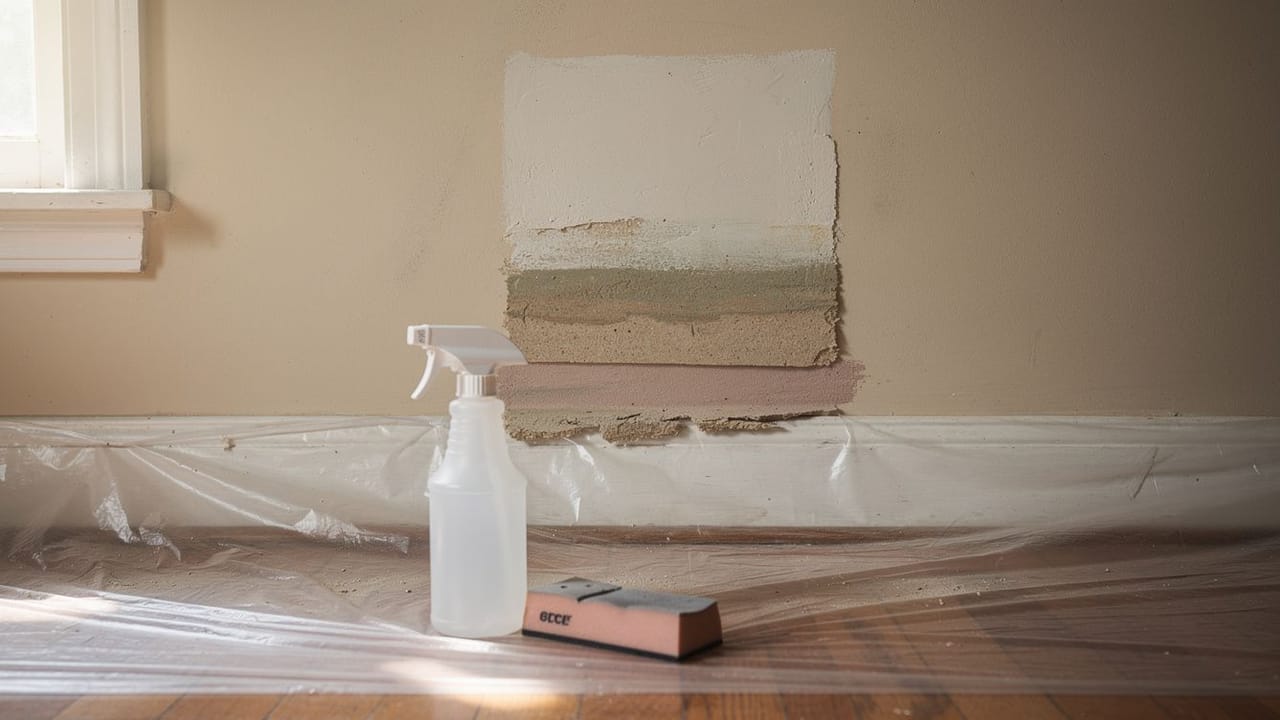
- Wet-dry sandpaper or a sanding sponge in place of a power sander
- A spray mister to wet the surface before sanding, scraping, drilling or cutting
- Heavy plastic sheeting for the floor and the work area
- A HEPA vacuum for cleanup, and a disposable N-100 respirator
How do you find out whether the paint has lead?
By testing it, and a job that tests negative falls outside the rule. Section 745.82 exempts a renovation when a certified inspector or risk assessor has determined in writing that the affected components are free of lead paint, when a certified renovator has tested each component with an EPA-recognized kit, or when a recognized lab has tested a paint chip collected by a certified renovator. The threshold is 1.0 milligram per square centimeter or 0.5 percent by weight.
The EPA page on lead test kits says a recognized kit used by a trained professional can reliably show that regulated lead paint is not present by a negative result. Only the negative is treated as reliable. A positive kit result, or no test at all, means the work is handled as if lead were there.
If you are hiring the work out, ask any contractor, us included, for the firm’s EPA certification before the job is scheduled. EPA keeps a search tool for lead-safe certified firms where you can look a company up. When you send us pictures of the damage, tell us the year the house was built and whether the walls have been tested, so the estimate for the drywall repair is written for the house you actually have. Our Nashville page covers the older neighborhoods where that question comes up most.
Sources
- U.S. EPA, Renovation, Repair and Painting Program — 1978 ban; about three-quarters of pre-1978 homes still contain some lead paint; certification required for paid work that disturbs paint; homeowner and rental applicability; list of authorized states, which does not include Tennessee.
- eCFR, 40 CFR 745.82, Applicability — Covers renovations for compensation in pre-1978 housing; exemptions for a negative inspector, test-kit or lab result at 1.0 mg/cm² or 0.5 percent by weight.
- eCFR, 40 CFR 745.83, Definitions — Minor repair and maintenance: 6 square feet per room inside, 20 outside; whole area removed counts; same room within 30 days is one job; demolition and prohibited practices excluded.
- eCFR, 40 CFR 745.85, Work practice standards — Signs, covered furniture and ducts, sheeting 6 feet out; high-speed sanding only with shroud and HEPA attachment; no open flame; heat gun below 1,100 °F; cleaning from the ceiling down.
- U.S. EPA, Lead Test Kits — A recognized kit used by a trained professional reliably shows lead paint is absent by a negative result.
- U.S. EPA, Lead-Safe Renovations for Do-It-Yourselfers — Testing recommended; wet-dry sandpaper, spray mister, plastic sheeting, HEPA vacuum, N-100 respirator.
- U.S. EPA, Locate Certified Renovation and Lead Dust Sampling Technician Firms — Search for EPA lead-safe certified firms.
FAQ
Lead Paint and Drywall Repair in an Older House — questions
Can I patch drywall in a house built before 1978 myself?
Yes. EPA says the federal rule generally does not cover homeowners working on their own house, unless they rent out part of it, run a childcare center there, or renovate to resell. EPA still recommends testing first and working wet, with plastic sheeting, a HEPA vacuum and an N-100 respirator.
Is it safe to sand joint compound on a wall that may have lead paint?
Not with a plain power sander. The rule bars high-speed sanding of painted surfaces unless the machine is shrouded and fitted with a HEPA vacuum attachment. EPA’s guidance for homeowners is to mist the surface first and sand by hand with wet-dry paper or a sanding sponge, then clean with a HEPA vacuum.
How do I know if my walls have lead paint?
Only a test tells you. A certified inspector or risk assessor can make a written determination, a certified renovator can use an EPA-recognized kit, or a paint chip can go to a recognized lab. EPA treats a negative kit result as reliable; a positive or untested wall is handled as lead paint.
Does the EPA lead rule apply to a small drywall patch?
Not if the paid work disturbs 6 square feet or less of painted surface in the room and uses no prohibited practice such as unshrouded power sanding. The count includes the sanded band around the patch and every piece of board cut out, and work in the same room within 30 days is added together.
Do landlords have to follow the lead rule when repairing a rental wall?
Yes. EPA says the rule applies when you rent out all or part of a pre-1978 home, so paid drywall work there above the minor-repair limit has to be done by a certified firm with trained workers. A landlord doing the work personally on a rental is covered as well.